
How Far Away Can You See a Drone Show?
By Antonio Liska •
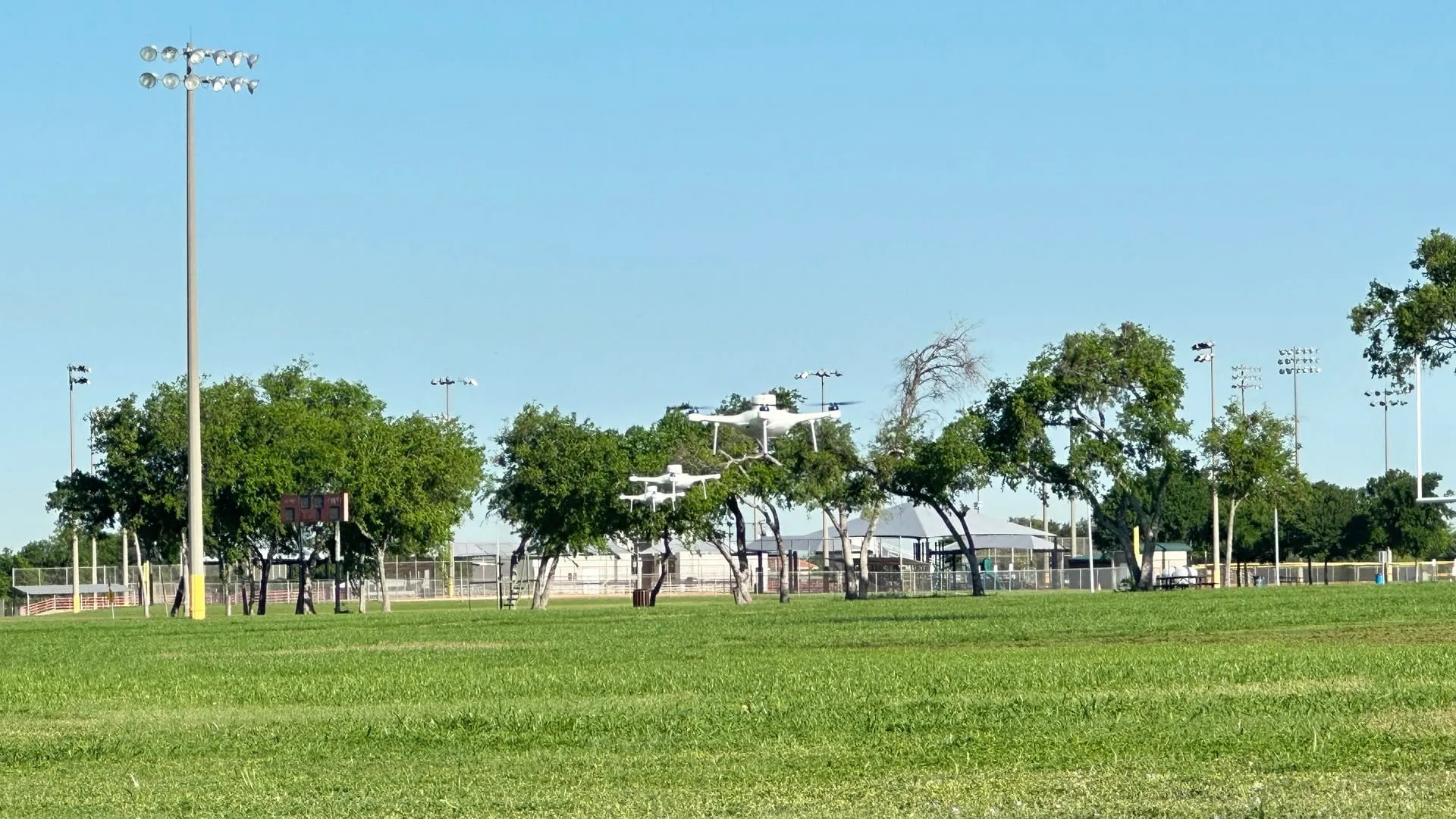
Short answer: you can see a drone show from about three miles away, but you can only read it from much closer. Every show drone carries lighting the FAA requires to be visible for three statute miles, so from that far out you will know something is in the sky. The logo, the text, the animation you paid for — those come into focus inside roughly a mile and look their best from a few hundred feet to a quarter mile, with the front row set by the safety standoff. Here is how the numbers work, what the sides and the back see, why a small show can sit closer than a big one, and how to lay out a venue so everyone gets a good seat.
Visible vs. readable: two different distances
A point of light against a dark sky is visible far beyond the distance at which you can tell what it belongs to. That gives every show two ranges:
- Visible distance — how far away someone notices “there’s something in the sky.” Show drones fly with anti-collision lighting that the FAA requires to be visible for at least three statute miles. That is a legal minimum for a single drone, and it is the honest working figure for the show as a whole. From three miles out, a 100-drone show is a faint cluster of points: you can tell something is there, but the color washes toward white, the motion is too small to follow, and your senses do not get much out of it.
- Readable distance — how far away someone can identify the picture: a logo, a number, an eagle. This is what your audience is there for, and it is set by the size of the formation, not the brightness of the lights.
Readable distance is geometry. Human eyes resolve roughly one inch of letter height per ten feet of distance — the same rule sign makers use. A formation 100 feet tall stays legible to about 1,200 feet; a 300-foot formation reads from about 3,600 feet. Lettering inside a logo drops out sooner than the outline.
Visibility by show size
More drones draw bigger, denser pictures, and bigger pictures read from farther away. Show drones keep a fixed spacing for safety, so formation size scales with drone count, and the altitude ceiling caps the height of the picture. The lights themselves are visible from about the same three miles no matter how many drones are flying; what changes with show size is how far away the picture holds together and where the front row can be.
| Show size | Typical use | Picture readable to | Sweet spot | Front row (standoff) |
|---|---|---|---|---|
| 20–50 drones | Private events: weddings, corporate, milestones | ~1,500 ft | 200–500 ft | A couple hundred feet |
| 100 drones | Public shows, fairs, community celebrations | ~1 mile | 600–1,000 ft | 400 ft at a 400-ft ceiling |
| 200+ drones | Brand reveals, product launches, headline moments | ~1 mile, more with a higher ceiling | 800–1,500 ft | Matches the ceiling, 400 ft or more |
These are planning ranges, not guarantees. They assume a clear, dark night, a formation that fills the available volume, and a ground-level viewer with a clean sightline. Three things move them:
- Altitude. Without airspace restrictions, show drones fly up to 400 feet above ground level; Drone Show Guys flies 400 feet or higher with special permission from the FAA. A higher ceiling means taller pictures and a longer readable distance — and a larger safety standoff, covered below.
- Swarm spread. A designer can spread 100 drones into one huge outline or pack them into a small, detailed logo. The wide outline reads from farther away but looks thinner up close; the packed logo rewards a closer audience with detail. Tell your designer where the audience will be and the show is sized for that seat.
- Proximity. Legibility is about distance; wow is about proximity. The same formation that is merely readable at a mile fills your field of view at a few hundred feet, and every color, every move, every drone is yours. Closer is almost always better, right up to the standoff line.
So the 600 to 1,000 feet the venue guide recommends is not a limit on who can see the show. It is the range where a 100-drone show looks the way it looked in the 3D preview.
Small shows get to sit closer
A 20-drone show takes very little vertical space. The formations are shorter, the ceiling is lower, and because the safety standoff scales with height, the audience can be a couple hundred feet from the drones instead of four hundred. That is a different experience: intimate, immediate, close enough to hear the swarm and watch individual drones move. Even 20 drones wow when they are up close and moving in sync. It is why small-scale shows work so well for weddings, backyard milestones, and corporate dinners: the picture is smaller, but the audience is inside it.
Can you see a drone show from all sides?
Yes — but not the same show. Every drone show is choreographed with a primary viewing direction, and what a given seat sees depends on how the formation was built.
2D formations — logos, text, flags, portraits, most animated characters — are drawn on a flat plane, like a giant screen facing the main audience. Straight on, they look exactly like the render. Toward the side the picture compresses; at 90 degrees it collapses to a thin line of lights. From behind, it is mirrored: text reads right-to-left.
3D formations — globes, spirals, helixes, tornadoes, bursts, rotating shapes — are built in volume and look right from every direction, which is why they anchor openers, transitions, and finales.
Good show design blends both. When an audience wraps around a venue, a designer rotates a 2D logo a full turn so every side gets a straight-on moment, keeps text short, and leans on 3D pieces for the spectacle. If your audience will be on two sides — both shores of a lake, two grandstands — say so early. It changes the storyboard, not the price.
The safety standoff sets the front row
The best viewing distance is not a matter of taste alone. Drone Show Guys flies under an FAA Part 107.35 waiver, whose terms require a buffer zone on the ground around the show, kept clear of non-participating people. The rule of thumb set by the FAA: for every vertical foot the drones fly, the audience is at least one foot away. Our safety and compliance page has the details.
So a show flying to 400 feet puts a restricted area at least 400 feet wide around the show, and our operators guard that line for the whole performance. Spectators can stand right up to the edge of it. That edge also happens to be a good seat: at 400 to 600 feet a 100-drone show fills a comfortable field of view.
Height and standoff trade against each other. A cramped venue can still host a show, but at a lower ceiling — a shorter picture and a shorter readable distance, and a front row that moves in with it. A venue with 1,000 feet of clear ground gives the designer the whole sky. And the standoff line is a safety line, not a suggestion: no vehicles near the operations area, no guests inside the buffer. Supplying licensed security for the buffer takes cost off the quote.
Weather, moon, and ambient light
- Full dark beats dusk. Colors wash out against a twilight sky. Plan the cue for at least 30 minutes after sunset; later is better.
- The moon barely matters. A full moon is far dimmer than a show drone, and city skyglow lowers contrast slightly without hiding a point of light.
- Stadium and parking-lot lighting does matter when it faces the audience. Bright lights in viewers’ eyes shrink their pupils and flatten the show. Dim or aim away any fixture pointed at the crowd; lighting behind the audience is fine.
- Haze, humidity, and smoke shorten the visible distance long before they touch readability at the sweet spot. Fog is the one condition that can hide a show entirely.
- Rain, wind, and lightning are safety limits, not visibility limits. Drones operate within established wind, precipitation, and storm thresholds; a show outside them is postponed, not flown. See the FAQ for weather policy.
Laying out a venue for the best view
- Pick the primary viewing direction first. Launch area, standoff, and formation orientation all follow from where most of the audience will stand.
- Give the audience 600 to 1,000 feet of clear ground toward the show for a 100-drone performance; a few hundred feet for an intimate show, more for a large one. The FAA standoff sets the minimum; the sweet spot sets the ideal.
- Check the sightline low, not just high. Formations spend time in the lower third of the show volume. A 50-foot tree line 200 feet in front of the audience blocks everything below about 14 degrees — at 800 feet, that hides the bottom 200 feet of the show. Stand where the audience will stand, at night, and look.
- Tell us about secondary audiences. A road, a neighborhood, a second shore: if people will watch from there, the storyboard can give them a show too.
Not sure your venue qualifies? The venue requirements guide covers takeoff surface, airspace class, and lead times; the pricing page shows what a show costs; and a note through contact starts an airspace review, which is part of every quote.
Frequently asked questions
How far away can you see a drone show?
About three miles as points of light: the FAA requires show drone lighting to be visible for at least three statute miles. At that range you can tell something is in the sky, but color and movement are mostly lost. The picture itself is readable from up to about a mile for a 100-drone show and looks best from 600 to 1,000 feet.
How far can you see a drone show?
Roughly three miles as lights; up to about a mile as a recognizable picture. Readable distance grows with the size of the formation, which depends on drone count and flight altitude, while the best seats are far closer than the farthest visible point.
Can you see a drone show from all sides?
Yes, but flat formations such as logos and text are designed for a primary viewing direction and appear compressed from the side and mirrored from behind. 3D formations look right from every direction, and designers rotate flat elements so wrap-around audiences get a straight-on view.
Can you see drone shows from a distance?
Yes. You will see the lights from about three miles away, though at that range the show is a faint cluster of points. To read the animations clearly, be within a mile, and ideally within 600 to 1,000 feet for a 100-drone show, or a few hundred feet for a small show.
Can you watch a drone show from any angle?
You can, and 3D formations reward every angle. For flat formations, the best seat is on the primary viewing axis the show was designed around. Tell your designer where the audience will be and the choreography is built for those angles.
Planning an event?
See our show packages, check the FAQ, or get a quote for your date and venue.
Book Your Show Now